
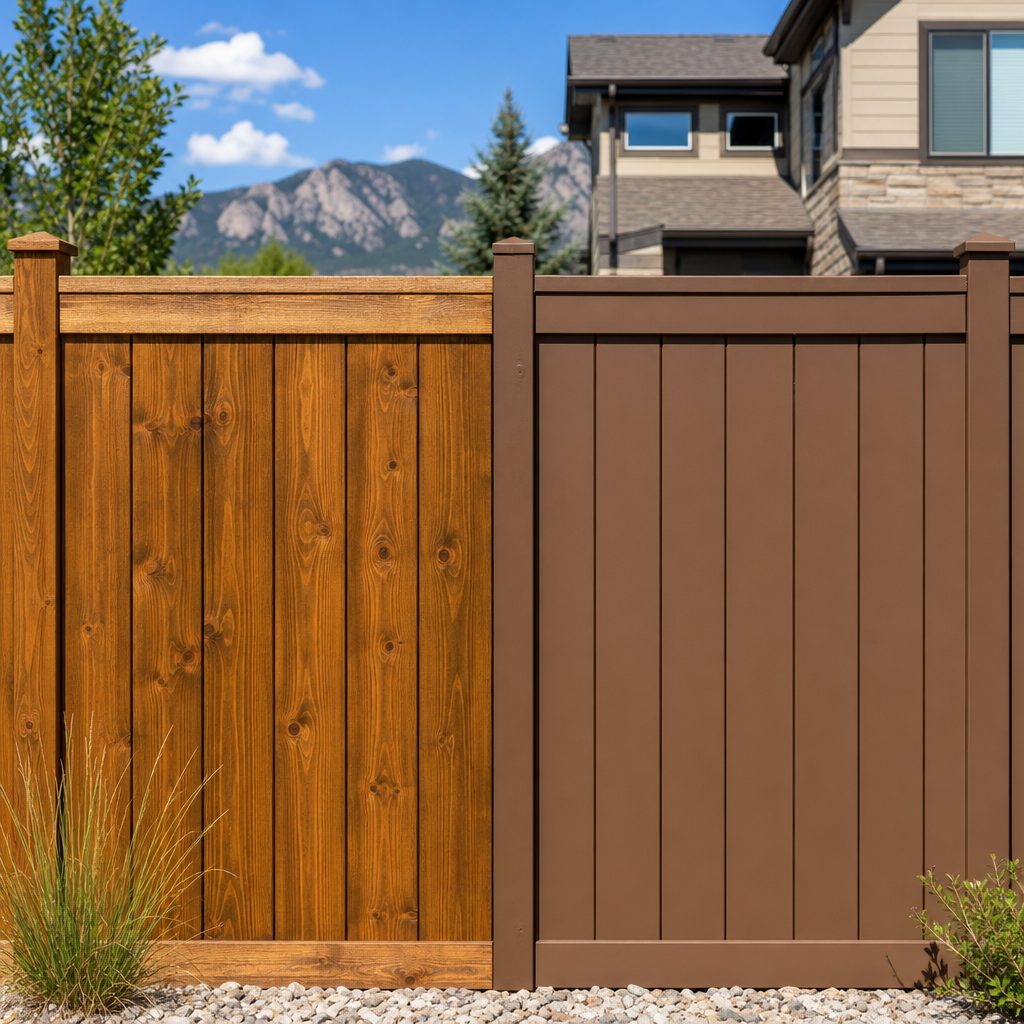
If you've priced out fence staining in Fort Collins or the surrounding area, you've probably run into the semi-transparent vs. solid stain question pretty fast. And if you're not a painter, the difference isn't always obvious — they're both "stain," right?
Not exactly. The choice between the two comes down to one thing above all else: the current condition of your wood. Get it right and your fence looks great for years. Get it wrong and you're restaining in half the time.
Here's how to think through it.
What Semi-Transparent Stain Does
Semi-transparent stain penetrates the wood rather than sitting on top of it. It adds color and UV protection while letting the natural grain and texture of the wood show through.
This is the right call for:
- New or recently installed fences — the wood is in good shape, the grain is worth showing, and penetrating stain bonds well to clean, fresh wood
- Fences with natural wood species — cedar and redwood in particular look excellent under a semi-transparent finish
- Homeowners who want a more natural aesthetic — semi-transparent reads as "stained wood," not "painted fence"
One thing to know: because it penetrates rather than coats, semi-transparent stain offers less surface protection. In Northern Colorado's climate — with 28+ freeze-thaw cycles per year and UV intensity running 10–15% higher than lower-elevation regions — semi-transparent finishes typically hold up 3–5 years before a recoat is needed.
That's not a knock on the product. It's just the tradeoff you're making for the natural look.
What Solid Stain Does
Solid stain is an opaque, pigment-heavy finish that covers the wood's surface rather than soaking into it. It hides the grain almost completely — closer in appearance to a paint than a traditional stain.
This is the right call for:
- Older or weathered fences — wood that's grayed out, showing surface checks, or has old stain remnants won't absorb semi-transparent product evenly; solid stain covers the inconsistencies
- Fences with repairs or mixed-wood sections — if you've replaced a few boards, solid stain unifies the look
- Maximum longevity — because solid stain sits on top of the wood, it forms a thicker protective barrier; a properly applied solid finish on well-prepped wood can last 5–7 years in Colorado conditions
The tradeoff: once you go solid, you generally stay solid. Putting a semi-transparent over a solid-stained fence is a headache that rarely goes well.
The Age Rule of Thumb
Not sure which category your fence falls into? Here's a quick framework:
| Fence Condition | Recommended Finish |
|---|---|
| New wood, less than 2 years old | Semi-transparent |
| Sound wood, original color visible | Semi-transparent |
| Grayed, weathered, or checked | Solid |
| Previously solid-stained | Solid |
| Repaired sections or patchwork | Solid |
If your fence is somewhere in the middle — maybe 4–5 years old, still structurally sound but showing some gray — a semi-transparent with a deeper pigment load can sometimes split the difference. That's a judgment call worth making in person.
Does Prep Change the Equation?
Yes, significantly. A fence that looks like a solid-stain candidate sometimes just needs a pressure wash and a light sand to come back. Clean, open wood grain absorbs semi-transparent product much better than dirty or sealed wood.
This is why an on-site quote matters more than a phone estimate. We look at what you're actually working with before recommending a finish.
What We Use in Northern Colorado
For fence staining projects in Fort Collins, Windsor, and surrounding communities, we spec products rated for Colorado's altitude and UV load — not off-the-shelf big-box stains that weren't formulated for this climate. The finish longevity numbers above assume properly matched, climate-rated products applied to prepared wood.
Our exterior staining work follows the same principle: the right product for the actual conditions, not the cheapest option that technically covers the surface.
The Bottom
Line
New fence? Semi-transparent — protect and enhance the wood while it still looks good.
Older or weathered fence? Solid — cover the damage, unify the look, and extend the life.
If you're in the Fort Collins area and want a straight answer on which finish is right for your fence, we'll come out and take a look — no charge. Get a free quote and we'll tell you exactly what we'd recommend and why.