
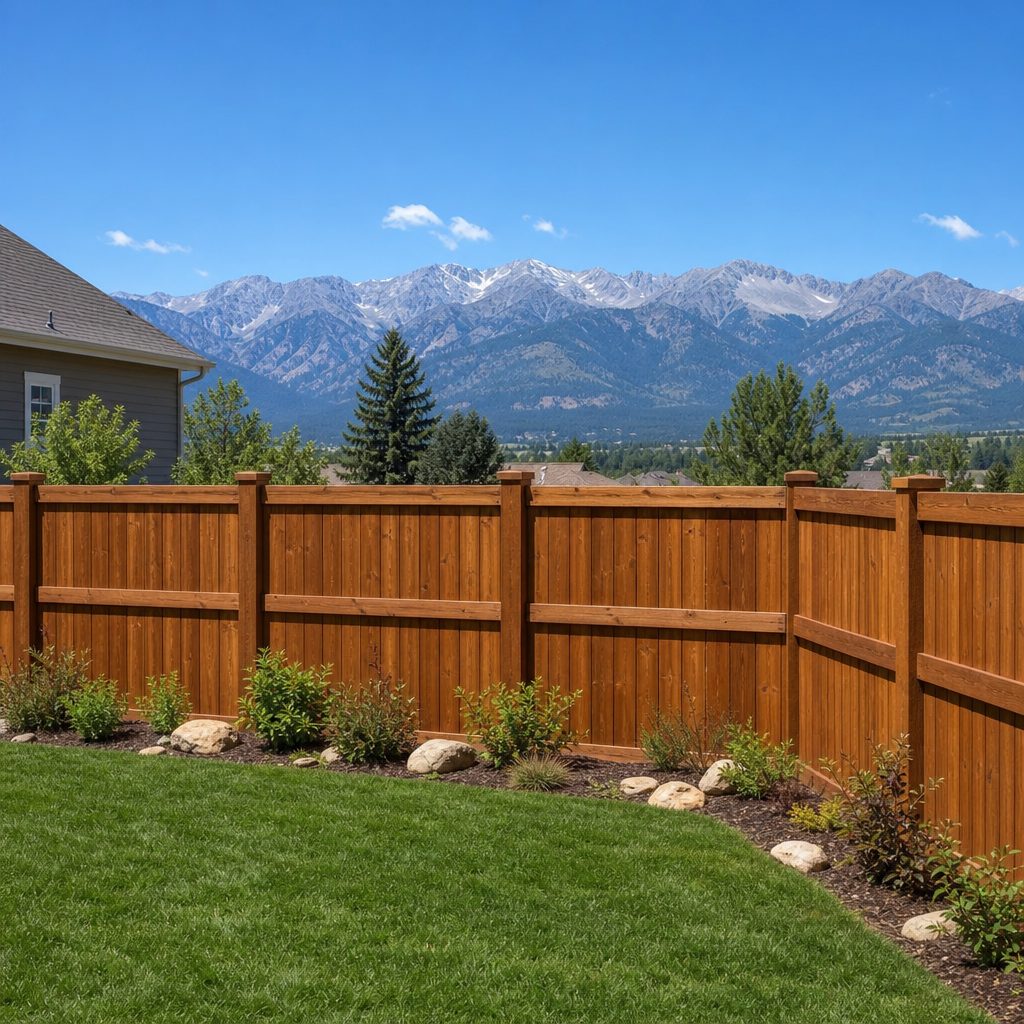
If you have a wood fence and you're wondering whether to stain it or paint it, you're asking exactly the right question — because the answer directly affects how long your fence lasts, how much maintenance you'll deal with, and what it'll cost you over the next decade.
For most homeowners in Fort Collins, Timnath, and Windsor, staining is the smarter long-term move. Here's why — backed by real-world performance data, not just opinion.
How Each Option Works
Before you can compare them, you need to understand the fundamental difference.
Paint sits on top of the wood. It forms a film layer that seals the surface. That sounds protective — and it is, initially. But wood is a living material. It expands and contracts with temperature and moisture. Over time, that movement cracks the paint film. Once water gets underneath, you're dealing with peeling, blistering, and rot.
Stain penetrates into the wood fibers. Instead of forming a surface film, it saturates the grain. When the wood moves, the stain moves with it. There's no film to crack, no seal to break.
In Northern Colorado — where we see 28+ freeze-thaw cycles per year and UV radiation running 10–15% higher than lower-elevation regions — that distinction isn't minor. It's the difference between a fence that lasts and one that needs attention every few years.
Pros and Cons: Stain vs.
Paint
Fence
Staining
Pros:
- Penetrates wood — won't peel, crack, or blister
- Breathable; allows moisture to escape without trapping it
- UV-resistant formulas protect against Colorado's intense sun
- Semi-transparent options enhance natural wood grain
- Easier recoating — no stripping or scraping required
- 3–5 year maintenance cycle for solid stains; semi-transparent may need touch-up sooner
Cons:
- Less color variety than paint (though solid stains cover this gap)
- Semi-transparent stains show weathering over time — intentional for some, not for others
- Won't hide existing damage or discoloration the way paint can
Fence
Painting
Pros:
- Maximum color control — any color imaginable
- Solid, clean look right out of the gate
- Can cover old stain (with proper prep) or hide significant discoloration
Cons:
- Film-forming — cracks and peels as wood expands and contracts
- Colorado's freeze-thaw cycles accelerate paint failure
- Repainting requires stripping peeling paint, which adds cost and labor every cycle
- Traps moisture if the surface seal is compromised, leading to rot
- Typically needs repainting every 3–5 years in this climate
The Real Cost Comparison
Let's look at a typical 150–200 linear foot wood fence.
| Stain | Paint | |
|---|---|---|
| Initial application | $600–$1,200 | $800–$1,500 |
| Prep for recoat | Minimal — light cleaning | Heavy — scraping, sanding |
| Recoat cycle | Every 4–6 years | Every 3–5 years |
| 10-year cost estimate | $1,200–$2,000 | $2,000–$4,000+ |
The gap widens fast. Painting is more labor-intensive at every recoat, and the cycles are shorter in Colorado's climate. Over a decade, staining usually wins on cost — sometimes by a significant margin.
What About HOA Requirements?
Many HOAs in Fort Collins, Windsor, and Timnath have specific fence appearance requirements. Most specify color — not finish type — so staining with a solid-color stain typically satisfies HOA guidelines while still outperforming paint on durability. If you're unsure, we're familiar with local HOA requirements and can help you navigate it.
What Type of Fence Does This Apply To?
This comparison is specifically about natural wood fences — cedar, pine, spruce. Composite, vinyl, and metal fencing have different rules entirely. For wood, penetrating stain is almost always the better long-term choice in this climate.
If your fence is already painted and you want to switch to stain, it's doable — but it requires proper prep to remove the existing paint film. That's something worth discussing before you commit to a direction.
Our Take: Stain Wins in Northern Colorado
We've applied fence stains and paints across Timnath, Windsor, Severance, and the greater Fort Collins area. The pattern is consistent — homeowners who chose quality penetrating stain have fewer callbacks, less maintenance, and better-looking fences five years out.
That's why our fence staining work uses products specifically selected for Colorado's altitude, UV exposure, and temperature swings. We don't use whatever's on the shelf — we use what holds up here.
Want a straight answer on what your fence actually needs?
We offer free on-site quotes and we'll tell you exactly what we'd recommend — and why. Request your free estimate and we'll get out to take a look.